
Can you have a garbage disposal with a septic system?
SepticFactsPublished Updated
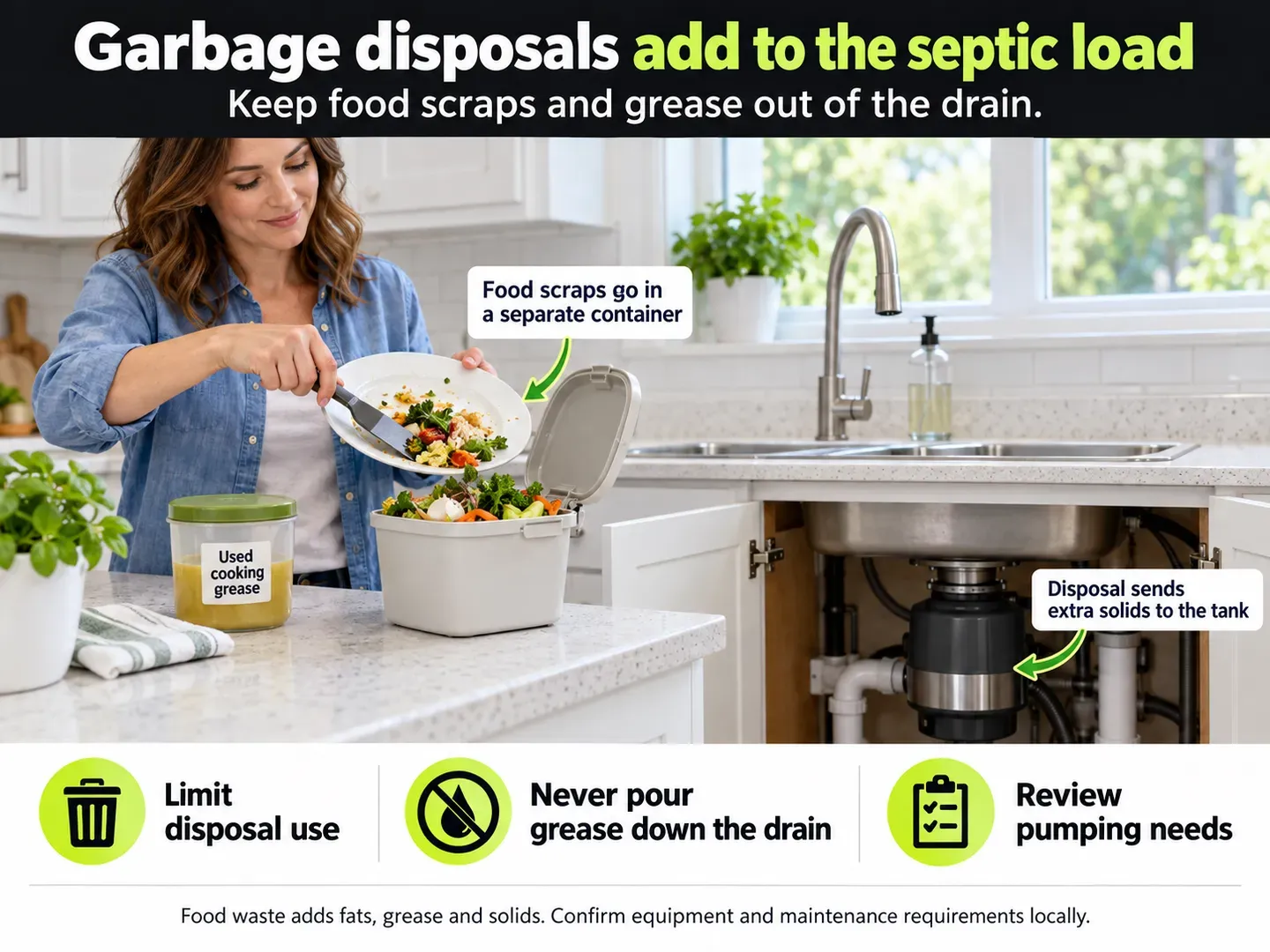
EPA and NC State Extension both advise limiting a garbage disposal’s use with a septic system.1 EPA, Washington’s Department of Health and NC State Extension each say food waste from a disposal can add solids.2 Local rules can differ, so confirm with the agency that issues septic permits where the lot is (often the county health department).
What does a garbage disposal do to a septic tank?
A septic system has a tank and a drainfield, and the soil treats the liquid that leaves the tank.3 A disposal sends food scraps down the drain, adding solid material to the system.4
How much more often do you need to pump a tank with a disposal?
EPA and Washington’s Department of Health both say a disposal can change how often a tank needs pumping.5 None of the sources gives a number for how much a disposal changes pumping.
For a baseline, EPA says household septic tanks are typically pumped every three to five years. In Washington, for example, the Department of Health says most septic tanks need pumping every three to five years.6 A licensed pumper who has seen the tank can say more than a general range.
What should you ask when buying a home or lot with a disposal?
Ask the seller when the tank was last pumped and how often it has been pumped. Ask whether a disposal is installed, whether it came with the house or was added later, and how often the household uses it. A pumping record shows how the system has been kept up.
If a seller says the disposal has never been a problem, ask for the pumping record rather than relying on that. A licensed pumper can look at the tank and say whether the schedule fits the household. Ask how much solid material the pumper found in the tank at the last pumping and whether the tank looked in good shape. If the system was set up without a disposal in mind, it helps to tell the pumper or that agency.
What can you do if you already have a disposal?
As noted above, EPA and NC State Extension advise limiting its use. Scraping plates into the trash instead of the sink is one practical way to do that. Keep the pumping record in one place, so the next owner or the pumper can see it. If you are unsure whether the system was set up for a disposal, ask a licensed pumper to look at the tank.
What should you tell the designer or the county?
If a new system is being planned, it helps to tell the designer and that agency about a planned disposal before the tank is sized. Ask what applies where the lot is. Local rules can differ, and that agency is the place to confirm them.
For how a tank and drainfield fit together, see conventional (standard) septic system. A SepticFacts screening estimate looks at the lot, not the kitchen, so a disposal is a question for the designer and that agency.
Citations
-
U.S. EPA, How to Care for Your Septic System (“Eliminate or limit the use of a garbage disposal”); NC State Extension, Septic System Owner’s Guide (“Restrict the use of your garbage disposal”). ↩
-
U.S. EPA, How to Care for Your Septic System; Washington State Department of Health, DOH 337-086; NC State Extension, Septic System Owner’s Guide. ↩
-
U.S. EPA, How Your Septic System Works; Oregon Department of Environmental Quality, About Septic Systems. ↩
-
Washington State Department of Health, DOH 337-086; U.S. EPA, How to Care for Your Septic System. ↩
-
U.S. EPA, How to Care for Your Septic System; Washington State Department of Health, DOH 337-086. ↩
-
U.S. EPA, How to Care for Your Septic System; Washington State Department of Health, DOH 337-086. ↩
The agency that issues septic permits where the lot is makes the final call on what system your lot can use.
Sources
- How to Care for Your Septic SystemU.S. Environmental Protection Agency, SepticSmart (federal)Corroborated; confirm with the authority. Checked
- Understanding And Caring For Your Septic System (DOH 337-086, October 2024)Washington State Department of Health with Washington State University Cooperative Extension Service (state)Corroborated; confirm with the authority. Checked
- Septic System Owner's GuideNC State Extension, North Carolina State University (state university extension)Corroborated; confirm with the authority. Checked
- How Your Septic System WorksU.S. Environmental Protection Agency (federal)Corroborated; confirm with the authority. Checked
- About Septic Systems (Residential Resources)Oregon Department of Environmental Quality (state)Corroborated; confirm with the authority. Checked
Check a specific lot
SepticFacts screens one lot against public soil, flood, wetland and slope data and the local septic rules we have on file, with every source cited.
Check a lot