
Is a standard gravity system set-and-forget?
SepticFactsPublished Updated
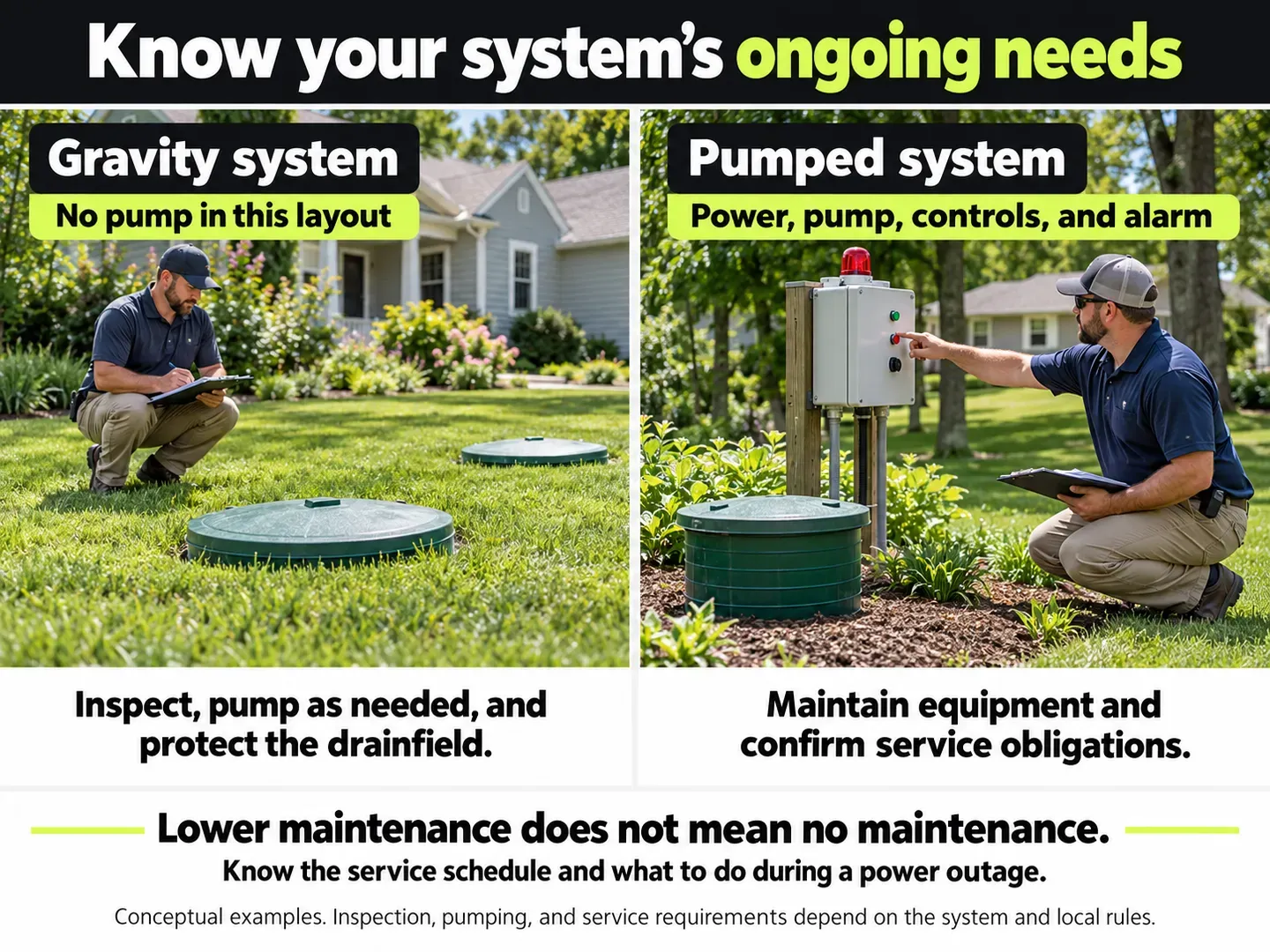
Lower-maintenance, not no-maintenance. EPA says household systems should be inspected at least every three years and tanks are typically pumped every three to five years.1 Between those, the owner’s job is to keep vehicles and structures off the drainfield, keep roof and irrigation water away, avoid flushing grease, wipes and chemicals, and fix leaks that overload the system.2 A neglected gravity system can fail, and a drainfield replacement is far more expensive than routine pumping.
Citations
-
U.S. EPA, How to Care for Your Septic System; Washington State Department of Health, Caring for Your Septic System; Penn State Extension, Septic System Basics. ↩
-
U.S. EPA, How to Care for Your Septic System; Washington State Department of Health, Caring for Your Septic System; University of Missouri Extension, Household Wastewater: Septic Systems (EQM104F); Clemson Cooperative Extension, Landscaping Over Septic Drain Fields; UF/IFAS Extension, Landscaping on or near Septic Drain Fields (SS687). ↩
The agency that issues septic permits where the lot is makes the final call on what system your lot can use.
Sources
- How to Care for Your Septic SystemU.S. Environmental Protection Agency (federal)Corroborated; confirm with the authority. Checked
- Caring for Your Septic SystemWashington State Department of Health (state)Corroborated; confirm with the authority. Checked
- Septic System BasicsPenn State Extension (university extension)Corroborated; confirm with the authority. Checked
- Household Wastewater: Septic Systems (EQM104F)University of Missouri Extension (university extension)Corroborated; confirm with the authority. Checked
- Landscaping Over Septic Drain FieldsClemson Cooperative Extension, Home and Garden Information Center (university extension)Corroborated; confirm with the authority. Checked
- SL474/SS687: Landscaping on or near Septic Drain FieldsUniversity of Florida IFAS Extension (university extension)Corroborated; confirm with the authority. Checked
Check a specific lot
SepticFacts screens one lot against public soil, flood, wetland and slope data and the local septic rules we have on file, with every source cited.
Check a lot