
What is a mound septic system?
SepticFactsPublished Updated
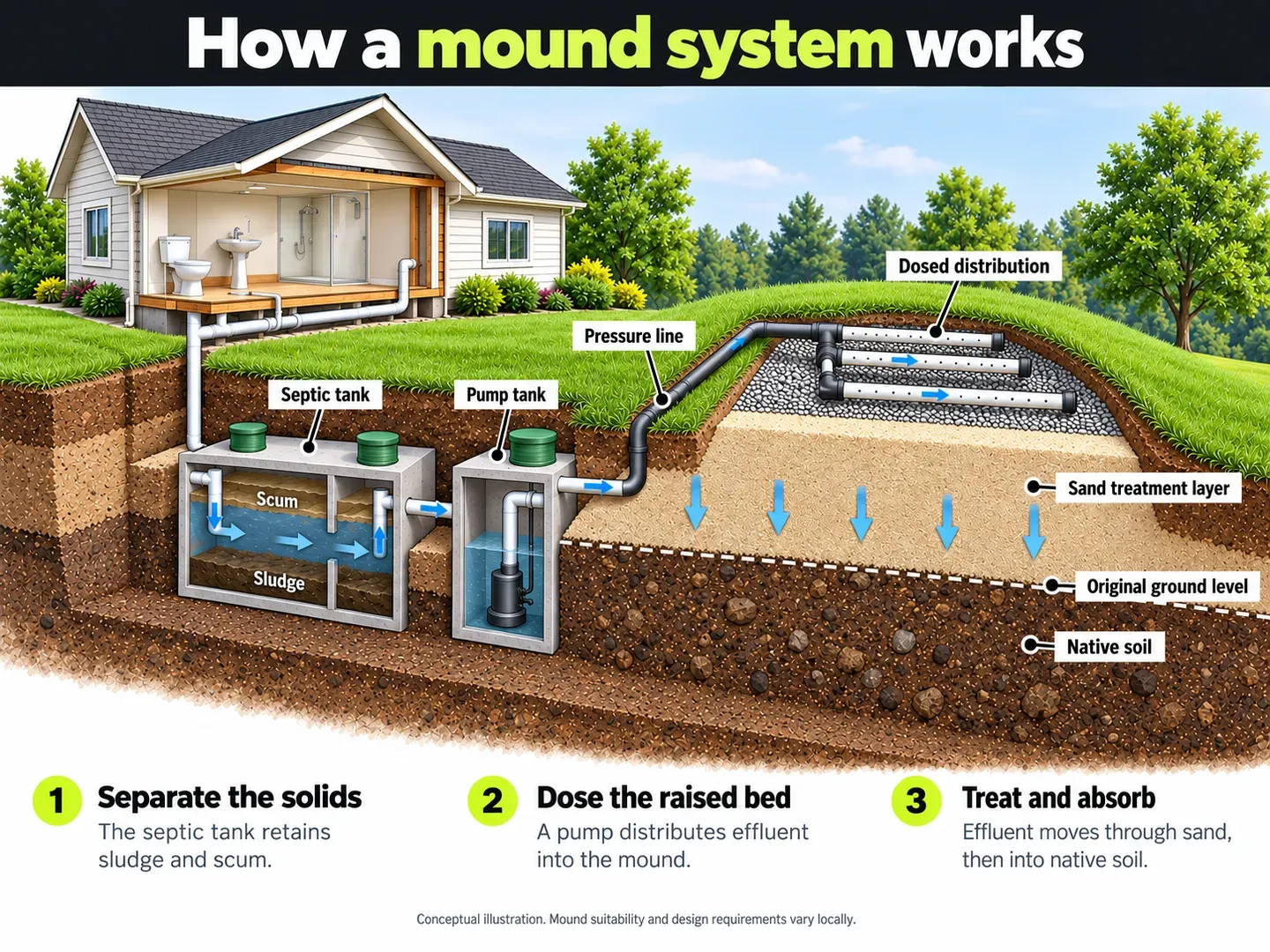
A mound septic system is a raised bed of sand above the natural soil surface that treats wastewater before it reaches the native soil.1 It is an option on sites with shallow soil, a high water table or shallow bedrock.2 Confirm with the agency that issues septic permits where the lot is (often the county health department) whether a mound could apply to a lot.
How does a mound septic system work?
A mound has three main parts: a septic tank, a pump chamber (also called a dosing chamber) and the mound.3 The pump chamber pumps the wastewater to the mound in controlled doses.4 Treatment happens as the wastewater moves through the sand and into the native soil.5
When might a county ask about a mound?
If a lot you’re weighing has shallow soil or a high water table, a mound is a system worth asking that agency about. Nebraska’s extension guide and the University of Minnesota’s septic program both describe mounds for sites with a high water table or shallow soil over bedrock.6
A SepticFacts screening looks at mapped soils, flood zones, slope and wetlands, plus local septic rules where SepticFacts has them for the county, so you can see what the data shows before you pay for a soil evaluation. A Yellow flag can mean a mound or another alternative system may be needed. That is a screening estimate, not a field evaluation, so confirm with that agency.
You can compare a conventional (standard) septic system.
What does one state’s rule say about mounds?
Minnesota is one example, not a national rule. The Minnesota Pollution Control Agency’s mound rule says clean sand must be used to elevate the bed that receives the wastewater, and the University of Minnesota’s septic program says a mound is a bed elevated by clean sand fill.7 Confirm the current rule with that agency.
For design numbers such as sand depth and slope limits, ask that agency which standard applies to the lot. Have a designer confirm it.
What are the disadvantages of a mound septic system?
A mound system needs periodic maintenance.8 It typically uses a pump to move the wastewater to the bed.9 The mound also sits above the natural soil surface.10 Before planning around one, ask the designer what maintenance the system would need and who would do it.
Is a mound more expensive than a conventional system?
Nebraska’s extension guide and EPA’s older mound fact sheet both describe the cost of a mound as typically higher than a conventional system.11 Costs depend on the county, the site and the design. Ask the designer or installer for a quote on the specific lot.
What care does a mound system need?
EPA’s older mound fact sheet and Nebraska’s extension guide both say the pump and floats should be checked annually.12 Ask the installer for a maintenance schedule for the specific system.
How often does the tank on a mound system need to be pumped?
EPA says household septic tanks are typically pumped every three to five years, and in Washington, for example, the Department of Health says most septic tanks need pumping every three to five years.13 How often depends on the tank and the household, so ask a licensed pumper.
Citations
-
University of Nebraska-Lincoln Extension, NebGuide G1475; U.S. EPA, Mound Systems fact sheet (EPA 832-F-99-074, 1999). ↩
-
U.S. EPA, Types of Septic Systems; University of Nebraska-Lincoln Extension, NebGuide G1475. ↩
-
University of Nebraska-Lincoln Extension, NebGuide G1475; Texas A&M AgriLife Extension, L-5414. ↩
-
University of Nebraska-Lincoln Extension, NebGuide G1475; Texas A&M AgriLife Extension, L-5414. ↩
-
U.S. EPA, Types of Septic Systems; University of Nebraska-Lincoln Extension, NebGuide G1475. ↩
-
University of Nebraska-Lincoln Extension, NebGuide G1475; University of Minnesota Onsite Sewage Treatment Program, All about septics. ↩
-
Minnesota Rules 7080.2220, Mounds (Minnesota Pollution Control Agency); University of Minnesota Onsite Sewage Treatment Program, All about septics. ↩
-
U.S. EPA, Types of Septic Systems; Texas A&M AgriLife Extension, L-5414. ↩
-
University of Nebraska-Lincoln Extension, NebGuide G1475; Texas A&M AgriLife Extension, L-5414. ↩
-
University of Nebraska-Lincoln Extension, NebGuide G1475; Texas A&M AgriLife Extension, L-5414. ↩
-
University of Nebraska-Lincoln Extension, NebGuide G1475; U.S. EPA, Mound Systems fact sheet (1999). ↩
-
U.S. EPA, Mound Systems fact sheet (1999); University of Nebraska-Lincoln Extension, NebGuide G1475. ↩
-
U.S. EPA, How to Care for Your Septic System; Washington State Department of Health, DOH 337-086. ↩
The agency that issues septic permits where the lot is makes the final call on what system your lot can use.
Sources
- Types of Septic SystemsU.S. Environmental Protection Agency (federal)Corroborated; confirm with the authority. Checked
- Decentralized Systems Technology Fact Sheet, Mound Systems (EPA 832-F-99-074, September 1999)U.S. Environmental Protection Agency, Office of Water (federal)Corroborated; confirm with the authority. Checked
- How to Care for Your Septic SystemU.S. Environmental Protection Agency, SepticSmart (federal)Corroborated; confirm with the authority. Checked
- Understanding And Caring For Your Septic System (DOH 337-086, October 2024)Washington State Department of Health with Washington State University Cooperative Extension Service (state)Corroborated; confirm with the authority. Checked
- On-site wastewater treatment systems, Mound system (L-5414)Texas A&M AgriLife Extension Service (state university extension)Corroborated; confirm with the authority. Checked
- Residential Onsite Wastewater Treatment, Mound Systems (NebGuide G1475)University of Nebraska-Lincoln Extension (state university extension)Corroborated; confirm with the authority. Checked
- All about septicsUniversity of Minnesota Onsite Sewage Treatment Program (state university extension)Corroborated; confirm with the authority. Checked
- Minnesota Rules 7080.2220, MoundsMinnesota Pollution Control Agency (state); official rule text published by the Minnesota Revisor of StatutesCorroborated; confirm with the authority. Checked
Check a specific lot
SepticFacts screens one lot against public soil, flood, wetland and slope data and the local septic rules we have on file, with every source cited.
Check a lot