
What is a perc test? How it differs from a soil evaluation
SepticFactsPublished Updated
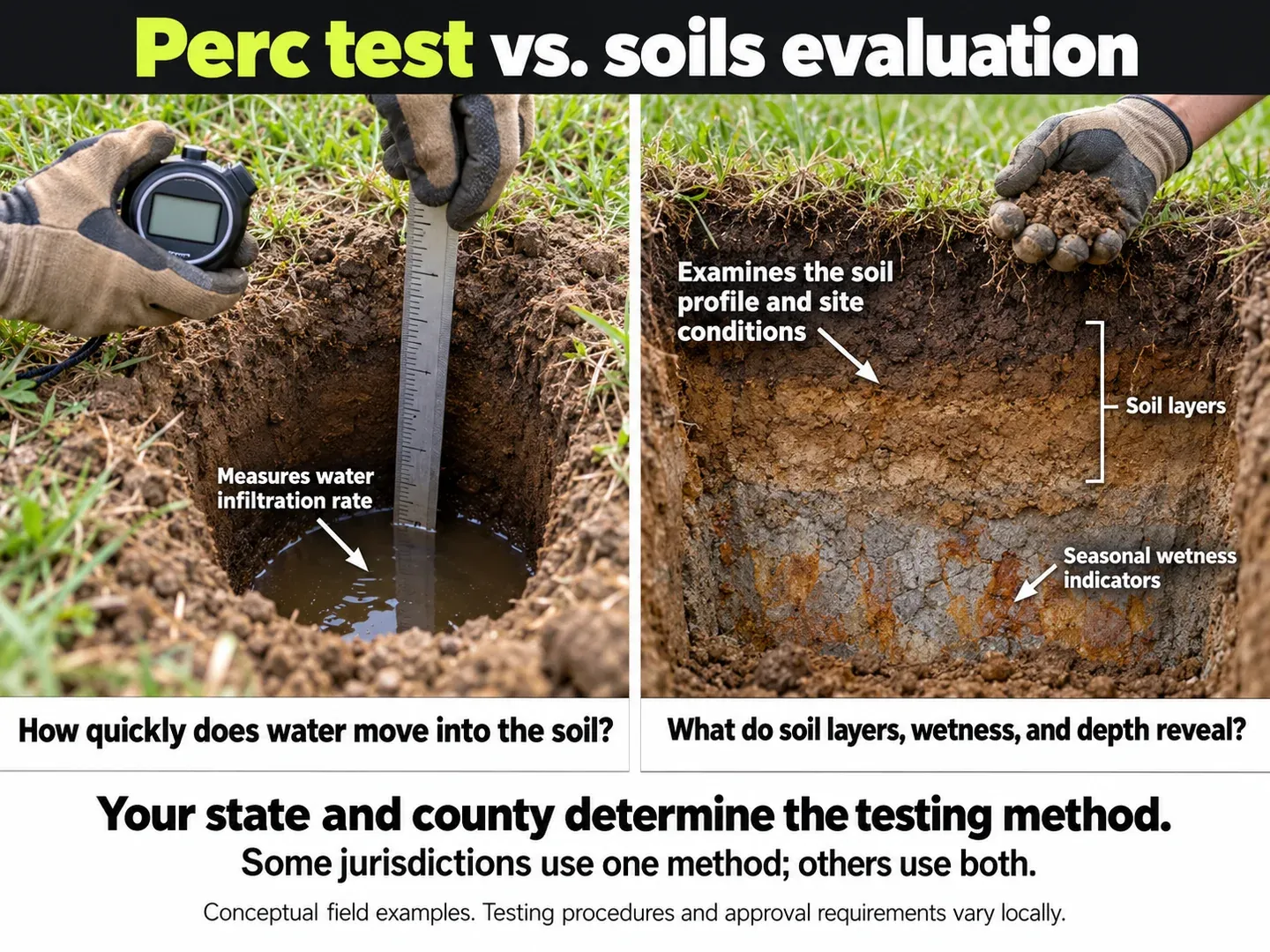
A perc test, short for percolation test, measures how fast water drains into a hole dug in the soil, timed in minutes per inch.1 It is typically one part of a larger site evaluation.2 A soil evaluation looks at the whole soil profile. Which one a county asks for, and what septic system a lot can use, are the county’s calls, or the state agency’s where one issues septic permits.
Both are field work done on the lot itself, and a desk review cannot stand in for either one. How the work is done, how deep it goes and how long results stay good differ by state and county. Rules named below come with the agency behind them. Where the answer is local, confirm it with the county.
Land buyers and homeowners are the usual readers. Builders, investors and realtors use the same information to qualify a lot that would need septic.
What a perc test is and how it works
What is a perc test?
A perc test measures how quickly water moves down through the soil. It turns that movement into one number: the minutes it takes the water level in a test hole to drop one inch, called minutes per inch.3 A low number means water drains quickly. A high number means it drains slowly.
The result is a number, not a verdict. What it means depends on the limits the state or county uses and on the kind of system being considered. That is why the county’s own guidance matters more than any figure found online.
How do perc tests work?
Someone digs a hole in the soil, adds water, and times how long the water level takes to fall one inch.4
Soil can differ from one spot to the next, so a reading is most useful from the area under consideration for the drainfield. The drainfield is the set of buried trenches or beds where effluent, the liquid wastewater that leaves the septic tank, soaks into the ground.
A perc test also has a limit built into it. It tells you about water movement in one hole on the day of the test. It does not by itself show what lies deeper, such as a layer of rock or a seasonal water table, which is the highest level groundwater reaches in the year. That is why a perc test is usually one piece of a larger picture, covered in the next section.
How far down do they dig for a perc test?
Depth depends on the county’s rules and on what the evaluator finds in the ground. Ask the county what depth it expects before anyone starts digging.
What the digging is meant to find stays the same from place to place. Evaluators identify limiting conditions, which are things like shallow groundwater that limit what the soil can do.5
What a soil evaluation is and what it looks for
What is a soil evaluation?
A soil evaluation, also called a soils evaluation or site evaluation, is an examination of the soil itself, usually in an open pit or a boring, which is a drilled soil sample rather than an open pit. The evaluator looks at each layer and writes down what is there. Both University of Minnesota and University of Maryland guidance describe the perc test as one part of a complete site evaluation.6
The evaluation covers more than water speed. It looks at the soil layers, the depth to groundwater or rock, and the lay of the land. The findings feed the decision on what kind of system the lot can use. That decision belongs to the county or its authorized evaluator, not to anyone reading a map.
What does the evaluator look for in the soil?
Three things come up repeatedly in extension guidance.
Texture is how coarse or fine each layer is. Both University of Minnesota and University of Maryland guidance list soil texture among the things an evaluator describes.7
Color is the second, and the next question covers it.
Depth is the third. The evaluator records how far down the workable soil goes before it meets groundwater or another limiting condition, the kind of condition that limits what the soil can do.8
How can soil color show where the water table sits?
The water table is the top of the groundwater, and it rises and falls with the seasons. For system design, the number that matters is its seasonal high point. University of Minnesota and Virginia Cooperative Extension guidance both treat soil color as evidence of that high point: gray colors in the soil profile are read as a sign of a seasonal high water table.9
Reading color takes training, and the interpretation belongs to the evaluator and the county.
Perc test or soil evaluation: which one does my county use?
What is the difference between a perc test and a soil evaluation?
A perc test measures one thing, how fast water drains in a hole, and reports it in minutes per inch. A soil evaluation examines the whole soil profile and decides what the profile can support. The perc test, where a county uses one, sits inside that larger picture.10
A soil evaluation can identify limiting conditions in the soil and geology, such as groundwater.11 A timed hole in one spot does not show these by itself.
Neither one is a permit. Both are information the county uses when it decides what to allow.
Which one does my county require?
That is the county’s decision, or the state agency’s where a state agency issues septic permits. Counties differ in what they ask for, and any national statement about it would be a guess.
The way to find out is a short call. Ask the county health department, or the agency that handles septic where the lot is, which test it asks for on a lot like yours, who may perform it, and how it schedules the visit. The article on what a septic soils evaluation requires walks through one worked example of an application, a site plan and test pits, so you know what kind of answers to expect.
Why land can come up short
Land can come up short on a perc test or a soil evaluation for a handful of reasons. Most trace back to one question: is there enough workable soil, with the right drainage, between the drainfield and the water or rock below? None of them settles a lot’s future on its own, because the county decides what system a lot can use and some of these limits can be answered with a different design.
Can soil drain too slowly?
It can. University of Nebraska-Lincoln Extension and Virginia Cooperative Extension guidance both treat slowly draining soil as a site restriction.12 Where a source names a specific cutoff, the cutoff belongs to that state, and the county’s own limit can differ.
Can soil drain too fast?
It can. Soil that drains too fast sends wastewater down before the soil has treated it. University of Nebraska-Lincoln and University of Minnesota guidance both warn about this: very fast-draining, coarse soil can move wastewater through before the soil does its work.13 Coarse sand and gravel are the usual examples. A fast reading is a limit of its own, not a sign of an easy lot.
How do a high water table and shallow rock affect a lot?
Both reduce the room the soil has to do its work. University of Minnesota guidance says trenches should not be installed in saturated soil, and Virginia Cooperative Extension says layers affected by a seasonal high water table are unsuitable for effluent that has not been disinfected.14 Both also treat shallow bedrock as a limiting condition.15
For a buyer, the practical point is to ask the evaluator what the soil layers show about water and rock before relying on how the lot looks on the surface.
Do slope and lot size matter?
Both can. North Carolina State Extension and the U.S. Environmental Protection Agency both list slope and lot size among the site factors that limit or shape which septic system a property can use.16 Both also point to space: poorer soil and site conditions can call for more room.17
Slope limits and space expectations are set locally. Ask the county how it treats slope and how much room it expects for a system and for the area kept free for a replacement.
What if my land comes up short?
A result outside the local limits does not necessarily end the question. It typically points toward a different design for that spot. The EPA and the University of Nebraska-Lincoln both describe mound systems as an option on sites with shallow soil over bedrock or a high water table.18 The EPA and Virginia Cooperative Extension also describe sand filters and aerobic treatment units (modular treatment units, sometimes called package plants) as alternative systems.19 North Carolina State Extension and Penn State Extension both describe alternative designs for sites where the soil limits a conventional system.20
These options come with tradeoffs. Mound systems typically rely on a pump that needs an annual check, and construction costs are higher than for a conventional system.21 Whether a county accepts a given option, and under what conditions, differs from place to place. A designer or evaluator can say what applies to your lot.
Two other steps are worth a call: ask the county whether public sewer serves the lot, and ask how it handles a lot where the first spot does not work. The page on what happens if land fails a perc test covers what a poor result typically means and what to ask the county about options.
Who does the test and what you arrange
Who performs a perc test or soil evaluation?
That depends on where the lot is. Ask the county whether its own staff or an authorized evaluator does the work, and whether you are expected to hire anyone. Ask before anyone digs, because a result from someone the county does not accept may not be used.
Can I do my own perc test?
You can time water in a hole yourself, but whether the county uses that number is the county’s decision. A home test answers one question, how fast water drains in one hole on one day. A complete site evaluation also looks at things like soil texture.22 If a do-it-yourself reading is useful to you, treat it as a rough personal check, and ask the county before you spend time or money on it as part of a purchase decision.
What should I sort out before the pits are dug?
Ask the county what it needs from you before the visit. Good questions cover access to the lot, whether property corners or building locations need to be marked, and whether it expects the pits to be dug ahead of time or on the day. The county’s checklist answers them, and the article on what a septic soils evaluation requires shows one worked example.
Decide the rough house position first, if you can. The drainfield, the well, the driveway and the house have to fit on the lot together, and the county may set minimum distances between them, so ask for them. The pit locations can help decide where the drainfield goes, so ask the county or evaluator whether you can share the planned house and driveway position before pit locations are chosen.
How long results stay valid
How long are perc test results good for?
Validity periods differ by state and local authority. Some places set a number of years.23 Ask whether your county also looks at whether the site and soil have changed.
That has two practical effects for a buyer. First, an old test on a lot you are looking at may or may not still count. Ask the county for the date of the result and whether it needs to be renewed or confirmed. Second, a lot that has been graded, filled or built on since the test may be treated differently from one that has not, so ask whether the county wants a new look.
Put the dates in your purchase timeline. A result that is current at contract may not be current at closing if closing is far away.
When to test: the role of the seasons
Does the time of year matter for a perc test or soil evaluation?
Often, yes. The water table moves through the year, and the design has to account for its seasonal high point. Evaluators read gray colors in the soil as evidence of that high point.24
Some places go further. Some jurisdictions use a wet season for testing or groundwater monitoring in some areas.25 The dates and the areas covered are set locally, so confirm them with the county rather than relying on a rule of thumb.
What if the county only tests in the wet season?
Then the season becomes part of your timeline. Missing the window can mean waiting for the next season. If a purchase depends on septic, ask the county when it evaluates, how long the wait is, and how it handles a lot that sits outside the usual window. Then set your contingency dates to match, before you make an offer. Also ask whether weather can delay a visit and how far out the calendar runs.
What it costs
How much does a perc test cost?
No single figure applies. The cost depends on the county and on the method it uses, and a national number would say little about a specific lot. The cost can have several parts, for example a county fee and the cost of having the pits dug. Ask the county for its fee schedule and ask any evaluator or excavator for a written quote.
The article on how much a perc test costs covers what goes into the cost and what to ask the county.
How a SepticFacts screening fits before field work
Where does a SepticFacts screening fit?
Without a screening, the first look at septic limits can come after money has been spent on field testing. A SepticFacts screening is a screening estimate that comes first. For a parcel it looks at mapped soils (USDA NRCS soil survey), flood zones (FEMA), slope (USGS elevation data) and wetlands (US Fish and Wildlife Service). Where SepticFacts has researched the county’s local septic rules, it adds them too, such as which test the county accepts, lot size, setbacks and whether an engineer is involved. The result is a Green, Yellow or Red flag, with its reasons and its sources.
It is not a soil evaluation, a perc test, a permit or an approval. The soil data is county-scale mapping, so unmapped pockets of different soil exist, and results can differ at the spot where a drainfield would go. The screening shows what the public data indicates, so you can decide whether field testing is worth paying for. The county or its authorized evaluator makes the final call, using the field evaluation. The article on how a SepticFacts report differs from a soils evaluation explains how the two differ and why they can disagree.
What should I do before paying for field work?
Start with the cheapest steps. Call the county health department, or the agency that handles septic where the lot is, and ask whether it asks for a perc test, a soil evaluation or both, who may perform it, and when it tests. Ask whether public sewer serves the lot, because if it does the septic question may not apply. Ask how long results stay valid and whether any existing test on the lot still counts.
Then sketch the house, driveway and well, and ask whether the county or evaluator will look at that plan before pit locations are chosen. Order the evaluation the county asks for before you spend money on house plans, and ask the evaluator which systems the result could point toward. Doing it in this order keeps the larger spending for last.
Citations
-
University of Nebraska-Lincoln Extension, NebGuide G1472, Conducting a Soil Percolation Test; Nebraska Department of Water, Energy, and Environment, Guidance Document 12-040, Soil Percolation. Both define the test as the time for the water level in a test hole to drop, expressed in minutes per inch. ↩
-
University of Minnesota Onsite Sewage Treatment Program, Soils and septics; University of Maryland Extension, FAQs on Septic Systems. Both describe the perc test as part of a complete or overall site evaluation. ↩
-
University of Nebraska-Lincoln Extension, NebGuide G1472, Conducting a Soil Percolation Test; Nebraska Department of Water, Energy, and Environment, Guidance Document 12-040, Soil Percolation. Both express the result in minutes per inch. ↩
-
University of Nebraska-Lincoln Extension, NebGuide G1472, Conducting a Soil Percolation Test; Nebraska Department of Water, Energy, and Environment, Guidance Document 12-040, Soil Percolation. Both describe timing how long the water level in a test hole takes to drop one inch. ↩
-
University of Maryland Extension, FAQs on Septic Systems (limiting factors in the soils and geology, such as groundwater levels, are identified); University of Minnesota Onsite Sewage Treatment Program, The impacts of soil color and depth to limiting condition on septic system installation (limiting conditions such as shallow groundwater or rock). ↩
-
University of Minnesota Onsite Sewage Treatment Program, Soils and septics (the percolation test is a small part of a complete site evaluation); University of Maryland Extension, FAQs on Septic Systems (a perc test is a component of an overall site evaluation). ↩
-
University of Minnesota Onsite Sewage Treatment Program, Soils and septics (soil texture is evaluated); University of Maryland Extension, FAQs on Septic Systems (soil texture is among the soil characteristics evaluated). ↩
-
University of Maryland Extension, FAQs on Septic Systems (limiting factors in the soils and geology, such as groundwater levels, are identified); University of Minnesota Onsite Sewage Treatment Program, The impacts of soil color and depth to limiting condition on septic system installation (depth to a limiting condition such as shallow groundwater or rock). ↩
-
University of Minnesota Onsite Sewage Treatment Program, The impacts of soil color and depth to limiting condition on septic system installation (soil color is used to determine the seasonal high water table for system design, and gray colors are the indicator); Virginia Cooperative Extension, On-Site Sewage Treatment Alternatives, Publication 448-407 (layers affected by a seasonal high water table are evidenced by gray colors in the profile). ↩
-
University of Minnesota Onsite Sewage Treatment Program, Soils and septics; University of Maryland Extension, FAQs on Septic Systems. Both place the perc test inside a larger site evaluation. ↩
-
University of Maryland Extension, FAQs on Septic Systems (limiting factors in the soils and geology, such as groundwater levels, are identified); University of Minnesota Onsite Sewage Treatment Program, The impacts of soil color and depth to limiting condition on septic system installation (limiting conditions such as shallow groundwater or rock). ↩
-
University of Nebraska-Lincoln Extension, NebGuide G1472, Conducting a Soil Percolation Test (a rate slower than the guide’s limit is unsuitable for a traditional soil absorption system); Virginia Cooperative Extension, On-Site Sewage Treatment Alternatives, Publication 448-407 (slowly permeable soil is a site restriction that mound systems are designed to overcome). ↩
-
University of Nebraska-Lincoln Extension, NebGuide G1472, Conducting a Soil Percolation Test (wastewater would travel too quickly through the soil to be treated properly); University of Minnesota Onsite Sewage Treatment Program, Soils and septics (soil that is too coarse will not do a good job of moving nutrients and bacteria). ↩
-
University of Minnesota Onsite Sewage Treatment Program, The impacts of soil color and depth to limiting condition on septic system installation (trenches should not be installed in saturated soil; soil color is used to find the seasonal high water table); Virginia Cooperative Extension, On-Site Sewage Treatment Alternatives, Publication 448-407 (layers affected by a seasonal high water table are unsuitable for disposal of effluent that has not been disinfected). ↩
-
Virginia Cooperative Extension, On-Site Sewage Treatment Alternatives, Publication 448-407 (shallow bedrock must be avoided); University of Minnesota Onsite Sewage Treatment Program, The impacts of soil color and depth to limiting condition on septic system installation (a limiting condition such as shallow groundwater or rock). ↩
-
North Carolina State Extension, Investigate Before You Invest, SoilFacts AG-439-12 (excessively steep slopes; larger lots needed where conditions are poorer); U.S. Environmental Protection Agency, Types of Septic Systems (site slope and lot size are among the factors in choosing a system). ↩
-
North Carolina State Extension, Investigate Before You Invest, SoilFacts AG-439-12 (much larger lots are frequently needed where soil and site conditions are not as good); U.S. Environmental Protection Agency, Types of Septic Systems (mound systems require a substantial amount of space). ↩
-
U.S. Environmental Protection Agency, Types of Septic Systems (mound systems are an option in areas of shallow soil depth, high groundwater or shallow bedrock); University of Nebraska-Lincoln Extension, Residential Onsite Wastewater Treatment: Mound Systems, NebGuide G1475 (mounds developed for sites including shallow soils over bedrock or a high water table). ↩
-
U.S. Environmental Protection Agency, Types of Septic Systems (sand filters and aerobic treatment units); Virginia Cooperative Extension, On-Site Sewage Treatment Alternatives, Publication 448-407 (media filter systems, which use media such as sand, and aerobic treatment units). ↩
-
North Carolina State Extension, Investigate Before You Invest, SoilFacts AG-439-12 (alternative systems for soils too wet or too shallow for a conventional system); Penn State Extension, Wastewater Management Private Septic Systems (alternatives and more complex distribution systems where percolation rates are slower or faster). ↩
-
University of Nebraska-Lincoln Extension, Residential Onsite Wastewater Treatment: Mound Systems, NebGuide G1475 (a mound needs a pump, the pump and floats are checked annually, and costs are higher than a conventional system); U.S. Environmental Protection Agency, Decentralized Systems Technology Fact Sheet: Mound Systems, EPA 832-F-99-074 (mounds require pumps or siphons, the pump and floats are checked annually, and construction costs are higher than conventional systems). ↩
-
University of Minnesota Onsite Sewage Treatment Program, Soils and septics (soil texture is evaluated as part of a complete site evaluation); University of Maryland Extension, FAQs on Septic Systems (soil texture is part of an overall site evaluation). ↩
-
Rhode Island Department of Environmental Management, 250-RICR-150-10-6 (supports a number of years for field data); Town of Sutton Board of Health, Massachusetts, Application for Percolation Test (supports a number of years for a completed soils test); North Carolina General Assembly, G.S. 130A-335 (sets different terms depending on the documentation provided, a plat or a site plan). ↩
-
University of Minnesota Onsite Sewage Treatment Program, The impacts of soil color and depth to limiting condition on septic system installation (soil color is used to determine the seasonal high water table, and gray colors are the indicator); Virginia Cooperative Extension, On-Site Sewage Treatment Alternatives, Publication 448-407 (gray colors in the profile evidence a seasonal high water table). ↩
-
Anne Arundel County Department of Health, Wet Season Percolation Testing (properties in certain areas may only be evaluated in the wet season); Rhode Island Department of Environmental Management, Wet Season Groundwater Monitoring Fact Sheet (wet season monitoring of the seasonal high groundwater table). ↩
The agency that issues septic permits where the lot is makes the final call on what system your lot can use.
Sources
- NebGuide G1472, Residential Onsite Wastewater Treatment: Conducting a Soil Percolation TestUniversity of Nebraska-Lincoln Extension (state university extension)Corroborated; confirm with the authority. Checked
- Guidance Document 12-040, Soil PercolationNebraska Department of Water, Energy, and Environment (state)Corroborated; confirm with the authority. Checked
- FAQs on Septic SystemsUniversity of Maryland Extension (state university extension)Corroborated; confirm with the authority. Checked
- Soils and septicsUniversity of Minnesota Onsite Sewage Treatment Program (state university extension)Corroborated; confirm with the authority. Checked
- The impacts of soil color and depth to limiting condition on septic system installationUniversity of Minnesota Onsite Sewage Treatment Program (state university extension)Corroborated; confirm with the authority. Checked
- On-Site Sewage Treatment Alternatives, Publication 448-407Virginia Cooperative Extension (state university extension)Corroborated; confirm with the authority. Checked
- Investigate Before You Invest, SoilFacts AG-439-12North Carolina State Extension (state university extension)Corroborated; confirm with the authority. Checked
- Wastewater Management Private Septic Systems - Penn State ExtensionPenn State Extension (state university extension)Corroborated; confirm with the authority. Checked
- Types of Septic SystemsU.S. Environmental Protection Agency (federal)Corroborated; confirm with the authority. Checked
- Residential Onsite Wastewater Treatment: Mound Systems (NebGuide G1475)University of Nebraska-Lincoln Extension (state university extension)Corroborated; confirm with the authority. Checked
- Decentralized Systems Technology Fact Sheet: Mound Systems (EPA 832-F-99-074)U.S. Environmental Protection Agency, Office of Water (federal)Corroborated; confirm with the authority. Checked
- Wet Season Percolation TestingAnne Arundel County Department of Health (county)Corroborated; confirm with the authority. Checked
- Wet Season Groundwater Monitoring Fact SheetRhode Island Department of Environmental Management (state)Corroborated; confirm with the authority. Checked
- 250-RICR-150-10-6 (DEM OWTS Rules)Rhode Island Department of Environmental Management (state)Corroborated; confirm with the authority. Checked
- General Statutes G.S. 130A-335North Carolina General Assembly (state)Corroborated; confirm with the authority. Checked
- Application for Percolation TestTown of Sutton Board of Health (city)Corroborated; confirm with the authority. Checked
Check a specific lot
SepticFacts screens one lot against public soil, flood, wetland and slope data and the local septic rules we have on file, with every source cited.
Check a lot