
Can I dump my RV into my septic system?
SepticFactsPublished Updated
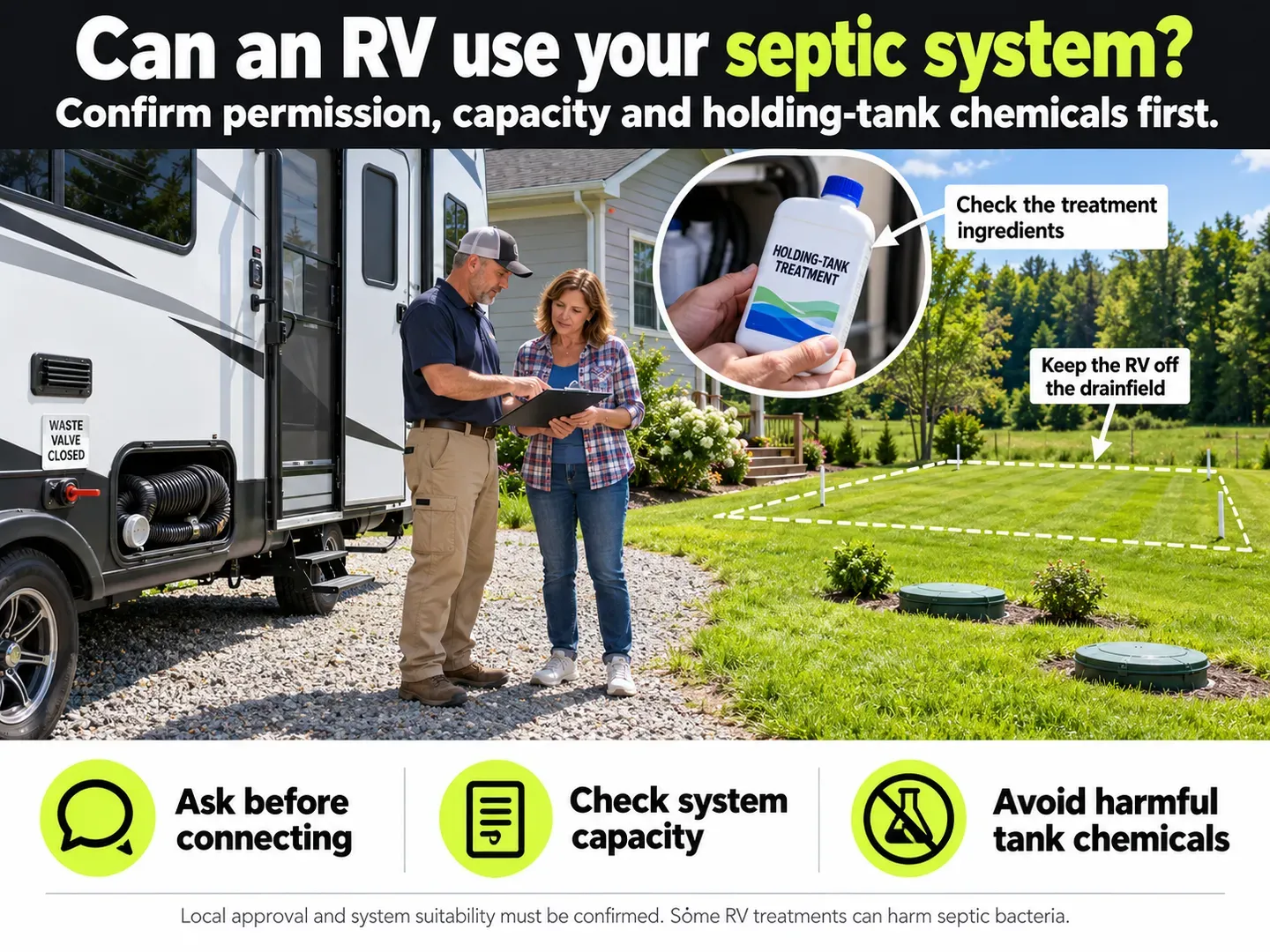
Sometimes, with care, and only if your county allows it. The main risk is chemistry: University of Arizona Extension warns that RV tank chemicals such as formaldehyde, glutaraldehyde, bronopol and para-dichlorobenzene “can kill the good bacteria in septic systems,” which stops treatment.1 If you do it, use only enzyme or bacteria-based RV treatments, dump full tanks slowly through a cleanout upstream of the septic tank rather than straight into the drainfield, and avoid dumping large volumes at once. A system sized tightly for the house may not have spare capacity for regular RV loads, and full-time RV occupancy on the lot may need its own approval.
Citations
-
University of Arizona Cooperative Extension, RV Holding-tank Treatments and Deodorizers in Septic Systems (AZ1233); U.S. EPA Region 9, Alert for RV, Boat and Mobile Home Owners and Park Operators About Safe Wastewater Disposal (EPA 909-F-99-002); California State Assembly, AB 1824 bill analysis (2010). ↩
The agency that issues septic permits where the lot is makes the final call on what system your lot can use.
Sources
- RV Holding-tank Treatments and Deodorizers in Septic Systems (AZ1233, revised 2018)University of Arizona Cooperative Extension (state university extension)Corroborated; confirm with the authority. Checked
- Alert for RV, Boat and Mobile Home Owners and Park Operators About Safe Wastewater Disposal (EPA 909-F-99-002, July 1999)U.S. Environmental Protection Agency, Region 9 (federal); archived copy hosted on EPA's January 2021 snapshot siteCorroborated; confirm with the authority. Checked
- AB 1824 (2009-2010 session), Assembly committee bill analysis, May 2010California State Assembly (state)Corroborated; confirm with the authority. Checked
Check a specific lot
SepticFacts screens one lot against public soil, flood, wetland and slope data and the local septic rules we have on file, with every source cited.
Check a lot