
What is a conventional (standard) septic system?
SepticFactsPublished Updated
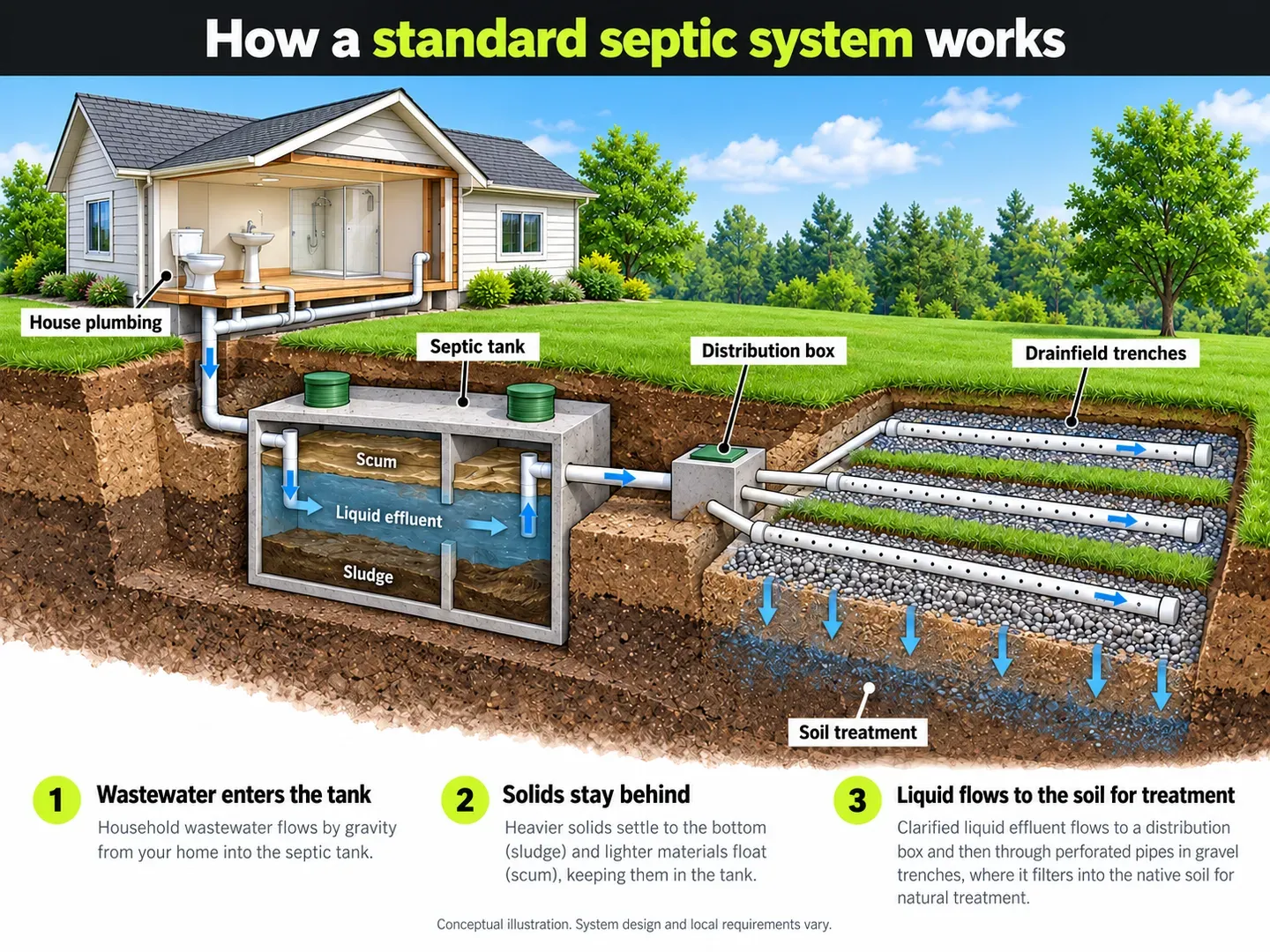
A conventional septic system is a septic tank plus a drainfield.1 It is also called a standard system. The soil in the drainfield treats the liquid from the tank.2 Whether a conventional system fits a particular lot depends on the site, so confirm with the agency that issues septic permits where the lot is (often the county health department).
How does a conventional septic system work?
Liquid from the septic tank flows to the drainfield.3 The drainfield typically uses trenches filled with stone or gravel, though some designs do not use gravel.4
What is the difference between conventional and alternative septic systems?
Some alternative systems include pumps.5 Oregon’s Department of Environmental Quality and Washington’s Department of Health both describe septic system types beyond the conventional one for sites where natural conditions limit treatment.6
Alternative systems with pumps or mechanical parts typically need more upkeep than a conventional system.7
Definitions of “alternative” can differ, so confirm with that agency which system a lot would need. One common alternative is covered in what a mound septic system is.
What kind of site does a conventional system need?
A drainfield works in soil that is not saturated with water for long stretches.8 That makes a conventional system the baseline, not a given for every lot.
Ask that agency how much soil depth above water or rock it expects for the lot you are weighing. Ask too which test it uses for a field evaluation, which is soil testing on the lot itself, and who performs it. Those answers tell you whether a conventional system is a realistic plan before you pay for field work.
What should you ask before buying a lot that would need a conventional system?
Start with that agency. Ask whether a soil evaluation or septic permit record already exists for the lot, and what it would require for a new evaluation. Ask whether public sewer is available. Then ask how long the evaluation takes, so you can build that time into the purchase.
How does a SepticFacts flag relate to a conventional system?
A SepticFacts Green flag means public data shows few mapped septic limits on the parcel and nothing that rules out a conventional system. A Yellow flag means septic looks possible, but expect an alternative system, an engineered design or extra steps. It can also mean some data was missing, or that a mapped floodplain is on or next to the parcel. The report shows which reason applies.
Mapped data is county-scale: unmapped pockets of different soil exist, and results can differ at the drainfield spot. Both flags are screening estimates, not field evaluations. Confirm with that agency.
How often does a conventional septic system need pumping?
EPA says household septic tanks are typically pumped every three to five years, and in Washington, for example, the Department of Health says most septic tanks need pumping every three to five years.9
How often depends on the tank and the household, so a licensed pumper or that agency can help set an interval for a specific tank. Ask the seller of a home or lot when the tank was last pumped, and ask for any pumping records.
Citations
-
U.S. EPA, Types of Septic Systems; Oregon Department of Environmental Quality, About Septic Systems. ↩
-
U.S. EPA, How Your Septic System Works; Oregon Department of Environmental Quality, About Septic Systems. ↩
-
U.S. EPA, Types of Septic Systems; Oregon Department of Environmental Quality, About Septic Systems. ↩
-
U.S. EPA, Types of Septic Systems; NC State Extension, Septic System Owner’s Guide. ↩
-
Washington State Department of Health, Types of Septic Systems; NC State Extension, Septic System Owner’s Guide. ↩
-
Oregon Department of Environmental Quality, About Septic Systems; Washington State Department of Health, Types of Septic Systems. ↩
-
NC State Extension, Septic System Owner’s Guide; U.S. EPA, How to Care for Your Septic System. ↩
-
U.S. EPA, How Your Septic System Works; University of Minnesota Onsite Sewage Treatment Program, All about septics. ↩
-
U.S. EPA, How to Care for Your Septic System; Washington State Department of Health, DOH 337-086. ↩
The agency that issues septic permits where the lot is makes the final call on what system your lot can use.
Sources
- Types of Septic SystemsU.S. Environmental Protection Agency (federal)Corroborated; confirm with the authority. Checked
- How Your Septic System WorksU.S. Environmental Protection Agency (federal)Corroborated; confirm with the authority. Checked
- How to Care for Your Septic SystemU.S. Environmental Protection Agency, SepticSmart (federal)Corroborated; confirm with the authority. Checked
- Types of Septic SystemsWashington State Department of Health (state)Corroborated; confirm with the authority. Checked
- Understanding And Caring For Your Septic System (DOH 337-086, October 2024)Washington State Department of Health with Washington State University Cooperative Extension Service (state)Corroborated; confirm with the authority. Checked
- About Septic Systems (Residential Resources)Oregon Department of Environmental Quality (state)Corroborated; confirm with the authority. Checked
- Septic System Owner's GuideNC State Extension, North Carolina State University (state university extension)Corroborated; confirm with the authority. Checked
- All about septicsUniversity of Minnesota Onsite Sewage Treatment Program (state university extension)Corroborated; confirm with the authority. Checked
Check a specific lot
SepticFacts screens one lot against public soil, flood, wetland and slope data and the local septic rules we have on file, with every source cited.
Check a lot